v0.8.0 — the snapshot-first RustFS migration, matter intake, and release hardening
This is a minor release under ADR 0025 because an existing bundled-store installation needs an
operator-led migration before the new image starts. Across the 48 merged PRs since v0.7.1, the
main story is making consequential operations visible: the object-store move has a snapshot and
rollback path, provider failures stop looking like empty successes, and matter intake opens a
governed autonomous session. An experimental orchestration chat now lets a model propose a plan
for approval before separate child agents work on a fictional agreement. The release also tightens
the checks that build and exercise what gets published.
Headline — migrate the bundled object store before starting RustFS (#594)
Section titled “Headline — migrate the bundled object store before starting RustFS (#594)”The bundled MinIO image is replaced by digest-pinned RustFS 1.0.0. The application still speaks to
an S3-compatible store; this changes the bundled deployment and its on-disk data. ADRs 0036–0037
add a deployment-operations journal, migration 0001, snapshot receipts, verification, and
snapshot-backed rollback. A code revert alone cannot restore migrated data.
Existing Compose and desktop installations need a snapshot-first migration. Take a separate
pg_dump, retain the old MinIO image, allow space for the volume snapshot, and keep the generated
snapshot for at least one release cycle. Do not run docker compose down -v. The
MinIO-to-RustFS runbook gives the exact plan → apply → up → verify
sequence, rollback commands, and the Helm, external-store, and multi-drive paths. A deployment using
an external S3-compatible store needs no bundled-volume migration. (#594, #583)
The application migration rehearsal used a
fresh v0.7.1 stack on Apple Silicon, with uploaded documents, a soft-deleted file, and a completed
export backed by real database records. Migration and snapshot rollback preserved every object’s
bytes and metadata. This synthetic workload does not establish compatibility with a long-lived
installation or the launcher-driven upgrade. Keep the snapshot and cached MinIO image until
verify and an existing-document check pass on your installation.
If you encounter problems during migration or after upgrading, please reach out to us through GitHub Discussions. Tell us which version you upgraded from and where the problem occurred so we can help investigate.
The old macOS app carries the obsolete MinIO Compose definition and cannot drive this migration;
install the new launcher first. Existing MINIO_* settings and the minio network alias remain
accepted through at least v0.10.0, with ADR 0036 retaining them for the rest of 0.x, so an
immediate .env rename is unnecessary. New installations should use OBJECT_STORE_*; RustFS-native
RUSTFS_* names remain inside the container manifest. (#594)
Other changes to read before upgrading
Section titled “Other changes to read before upgrading”- Required skill inputs now reach their declared contract. Direct API callers that omit one get
400 skill_input_missing. Correction recorded 2026-10-08: the v0.8.0 web composer did not collect required inputs for built-in skills, so attaching one could fail with the same error (#668). #669 fixes the composer for the planned v0.9.0 release. The enhance-prompt path supplies its ownraw_inputand keeps its provenance marker out of ordinary skill assembly. (#570) - Chat tool confirmation needs
LQ_AI_MCP_MASTER_KEYfor new pending calls. The pending payload is encrypted at rest; writes fail closed without the key, and a missing or wrong key denies resume with409. Older plaintext pending rows remain readable until their short TTL expires. Configure and retain the key before using this path. (#403) - Anthropic’s omitted output limit rises from 4,096 to 16,384 tokens. A provider
default_max_tokensoverrides it, and an explicit request limit still wins. Invalid provider defaults stop startup with a named error. Set the provider default if the earlier ceiling matters to a deployment. (#317) - Adapter timeouts default to 600 seconds for Anthropic, OpenAI/Azure, and Ollama; a provider
timeout_soverrides the default. A timeout is reported asclient_timeoutrather than as an apparent provider outage. Chat history also defaults to 64,000 tokens, preserving more of a large attachment for the next turn. (#318, #504) - Bridge OAuth cancellation now checks its state before rendering a page. A cancellation with
missing, expired, or invalid state returns JSON
400; restart the installation from the admin UI. Live provider consent and cancellation flows still need hands-on verification. (#633)
Public security advisories
Section titled “Public security advisories”Three published advisories cover fixes in this release:
- Autonomous resource ownership: schedules, watches, and manual runs now check ownership of referenced playbooks and knowledge bases. Artifact emission rechecks ownership of the target knowledge base. (#411, #569)
- Skill-input assembly: the gateway now encloses unused inputs in a labelled JSON data block and escapes input-created assembler headings. This preserves prompt structure; untrusted content still reaches the model’s system message. Moving it to a data channel remains separate work under DE-388. (#634)
- Bridge OAuth callbacks: Slack and Teams callback pages now validate state before rendering, escape dynamic text, and send restrictive response headers. (#633)
Governed work, with an explicit demonstration boundary
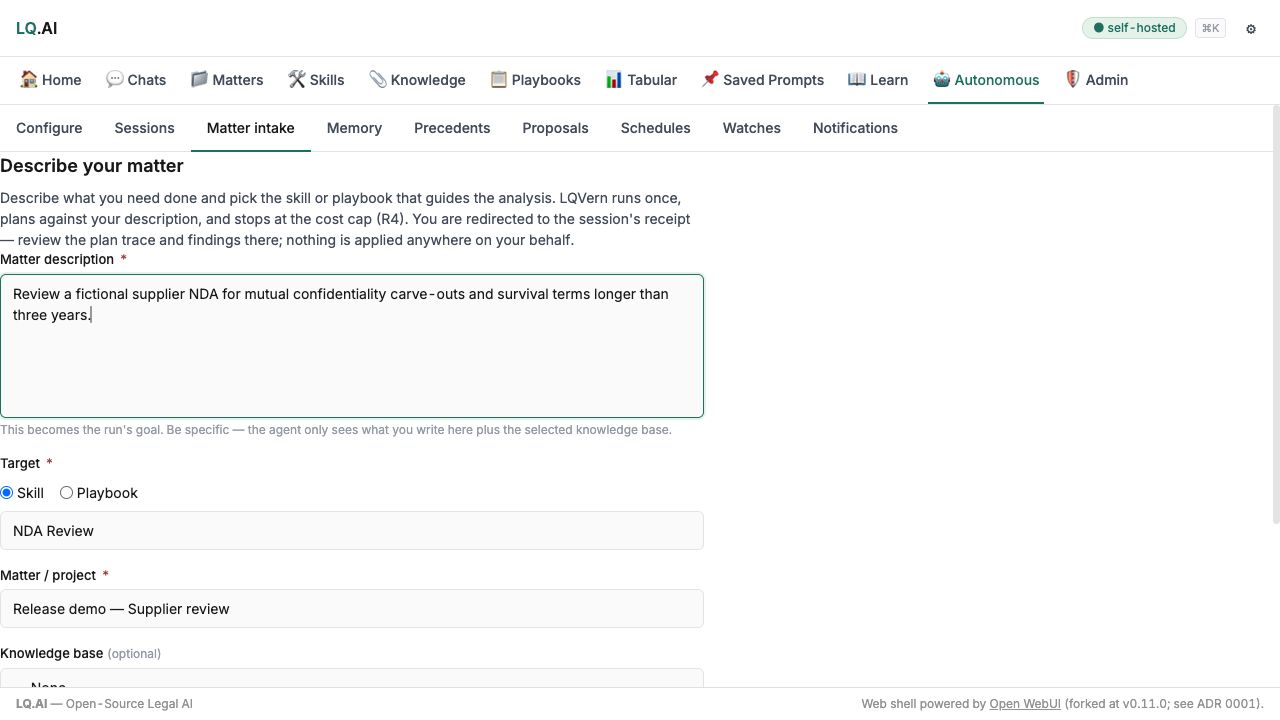
Section titled “Governed work, with an explicit demonstration boundary”A new matter-intake page starts a governed autonomous session from a description, an owned project, and a chosen skill or playbook, then opens its trace and receipt. Existing query-less API calls still work. (#410)
The experimental Orchestration chat under Autonomous sessions replaces the earlier sample-only preview. The owner asks a question about one fictional vendor agreement. A configured model proposes one to four bounded tasks; the owner reviews and approves the exact plan before separate Contract QA children run. The root model combines their retained findings in the same conversation. Plans, approval, child receipts, and working files remain inspectable. The demonstration uses a direct model route but no live sources or real matter documents; answers are unverified. (#596, #631)
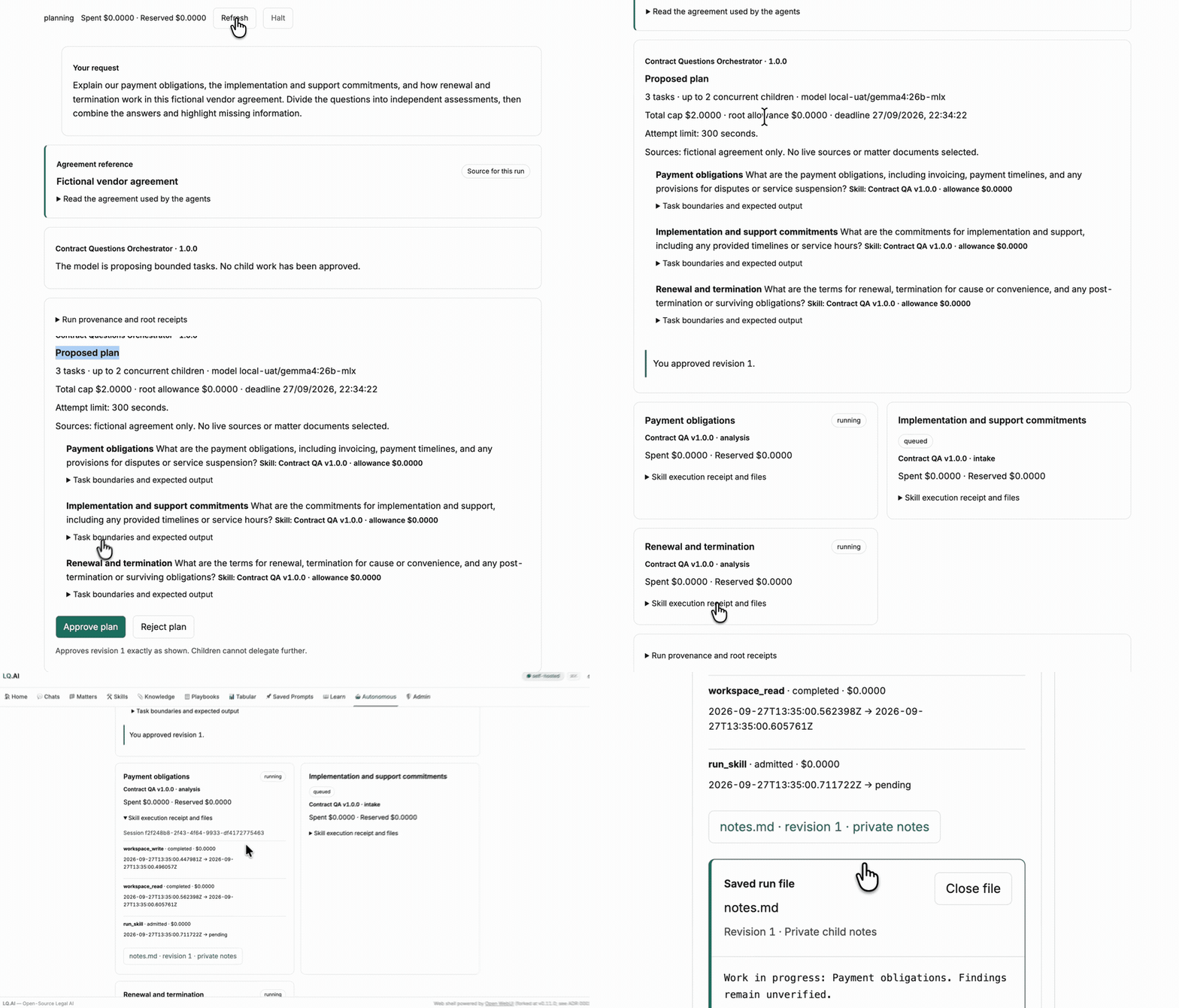
Watch the full 68-second demonstration, including the child results and combined answer. The recording uses a local model and a fictional agreement.
The chat is off by default. To try it, configure a dedicated demo project, a priced direct model
route, the installed skills, and LQ_AI_ORCHESTRATION_CHAT_ENABLED=true on the API and arq worker.
The ADR 0035 chat UAT runbook has the setup and limits. Turning the
flag off prevents new planning and approval while retained runs remain readable and haltable.
Persistent skill workspaces and bundled helpers have separate gates and are not exercised by this
chat. Children are governed application runs inside the shared worker, not isolated processes.
(#631)
Correctness and user-facing fixes
Section titled “Correctness and user-facing fixes”- A provider stream that yields no content now reports a typed failure, records a failed routing row, and does not persist an empty successful assistant turn. Anthropic streamed tool-input fragments are assembled into compatible tool-call deltas. (#504, #395)
- Schedule, watch, and manual autonomous runs reject missing or unowned playbook and knowledge-base references before saving them. Artifact emission checks target-KB ownership again before upload, so a rejected target leaves no orphan object. (#411, #569)
- Multiple artifact-storage failures are combined into one useful warning while each attempt keeps its audit row. Gateway tool-choice mappings are documented and pinned by tests. (#414, #394)
- Per-chat model selections now survive a browser refresh, with a fallback when the saved model is unavailable. The System theme now falls back to light instead of taking the operating system’s dark preference into LQ.AI’s partial dark styling. (#264, #280)
Test and release pipeline
Section titled “Test and release pipeline”- The deterministic Cypress track runs nightly against the Compose stack without live provider keys. It prepares SvelteKit before launch, bounds a stalled step, and keeps failure diagnostics. (#432, #602)
- CI enforces an 80% API coverage floor and an 88% gateway ratchet. API pytest runs in parallel with worker-local databases and a lockfile-keyed uv download cache. (#433, #561)
- Stack smoke runs for deployment-operations changes and probes dependencies imported only on first use. CI also builds reviewed helper images and runs their acceptance checks. (#594, #600, #596)
- The release-image check catches missing community skill manifests. Image builds and attestations now run in an isolated reusable workflow; Dockerfile bases and release-Compose stock images use pinned digests. The web image skips an unused ONNX CUDA download. (#537, #598, #603, #595)
- Pinned GitHub Actions were refreshed for Python and Node setup, artifact upload, caching, image builds, and the grouped Actions updates. (#547, #548, #549, #606, #607, #608)
Documentation and maintenance
Section titled “Documentation and maintenance”Reference reverse-proxy overlays now cover Caddy, Traefik, and nginx, and the Slack and Teams bridge examples use their correct public callback paths. The test strategy maps suites to product surfaces. ADRs 0027, 0028, and 0035–0037 record the request-budget, documentation-site, orchestration, and migration decisions; a documentation-site mini-PRD defines the planned journeys and work items. Fourteen already-implemented roadmap rows now point to their completion evidence. (#429, #568, #431, #573, #580, #567, #583, #511, #404)
Dependency maintenance refreshed the web build base, Compose pgvector digest, API and gateway groups, typing stubs, and workflow action pins. These updates are included in the range but do not change the operator steps above. (#613, #612, #610, #609, #557, #555, #547–#549, #606–#608)
Who built this release
Section titled “Who built this release”Four people have their first author or co-author credit on main in this range.
Contributor What they landed
- @dropthejase
- per-chat model selection that survives a refresh (#264)
- @iris-ng
- co-authored the documentation-site mini-PRD (#511)
- @nanparth
- digest-pinned Docker bases and Dependabot image updates (#603)
- @Shahlawyers
- deferred-import probes in stack smoke (#600)
Four contributors returned. @SaifAlYounan built the matter intake, ownership checks, encrypted tool confirmation, streaming fixes, and coverage and Cypress gates (#410, #411, #403, #504, #395, #433, #432). @sergiomaldo worked on Anthropic output and timeout behavior and the release-image skill check (#317, #318, #537). @sgbooth fixed the System-theme fallback (#280), and @ThurgyThurg parallelized API tests and added the uv cache (#561).
Maintainer work by @houfu includes the RustFS migration, skill-input
enforcement, the target-KB ownership check, the governed run tree and model-backed orchestration
chat, the gateway assembler and bridge callback fixes, the reusable release-image workflow, and the
Cypress startup repair (#594, #570, #569, #596, #631, #634, #633, #598, #602).
Dependabot supplied the dependency, image, and workflow-action updates.
That is nine human contributors in this release, four appearing in the main history for the first
time.
Schema
Section titled “Schema”The API’s Alembic head moves from 0066 to 0068. Migration 0067 adds the orchestration run
tree and durable model-planning state, backfills existing autonomous sessions, and adds indexes and
a trigger; on a populated database, allow for a one-time write and table lock. Migration 0068
adds optional skill workspaces. Both migrations apply even while the orchestration chat flag is off.
The object-store migration is separate: its 0001
and receipts live in the deployment-operations journal, not the application database. (#596, #594)
Honest scope
Section titled “Honest scope”The orchestration chat is model-backed, fictional-input-only, and off by default; enabling it does not turn the shared arq worker into a network-isolated process or grant access to real matter documents. The skill-input envelope preserves prompt structure but does not isolate untrusted content from the model’s instruction channel. The migration runbook covers an existing bundled store; external S3-compatible stores follow their own deployment path.
- Upgrade — the runbook for taking this release.
- Release versioning — what a patch and a minor each commit to.
- All release notes — every tag, and which have notes.